1. Theory for theory's sake, when critical, is nothing but the faith that theory will, if only in the end, emerge, as in a dialectical unfolding, for its other, that is, for political practice.
2. The totality is the infinity of determinate negation, which infinity is the expressive self-containment of the finite--in its own expressive curtailment it penetrates the truth of its own inner void.
3. A concept is immanent to the extent that it is objectively there. This translation is one that typically cannot avoid creating a metalanguage between object and concept, and therefore a metalanguage on thin air--but air is needed to breathe.
4. The self-abstraction of the capitalist system is the hidden truth of bourgeois masochistic wish-fulfillment: to confront the reality of market functioning is enough to invite claims of exception, thereby proving the rule, that reality is indeed a Freudian dream.
5. The immanent critique of capitalist society needs no conscious material on which to work; rather, it is enough that a self-understanding be allowed to emerge from the social unconscious. The concepts contained therein--and surely they are there--are already universals, carrying out their abstractions under the cover of apathy. This is where practice enters the picture.
6. Not particularity, but peculiarity is the mark of the potential for liberation today. The tragedy is that nostalgia has usurped that apparatus which is the infinite machine of peculiarity production, the dream-logic of the inattentive mind. This is capitalism's well-known basis in the ideology of nostalgic progress.
Showing posts with label totality. Show all posts
Showing posts with label totality. Show all posts
Tuesday, October 22, 2013

Sunday, September 29, 2013
To The Things Not-in-Themselves!

Positivity is bad faith--this could be the slogan of our times, the latter designation applying to the post-WWII world. Everything turns upon this negation.
The positive as that which is itself in itself, or rather even for itself, cannot be but is. We cannot help doubting the utter inconceivability of something complete, even as we strive for it in all branches of thought, positive or negative as they may be. This is the great paradox, that thought as universal becomes its dialectical opposite, that negation of which the determinateness of all being is constituted. Positivity being bad faith, where does that leave negativity? One cannot be utterly negative, try as Adorno did. The time for that striving for completeness in incompleteness has come and gone. But this criticism is not just one blindly putting forth the positivity in all things due to their givenness--this Hegel destroyed in the very first deduction of the Phenomenology of Spirit. Rather, what we are left with is the quality of positivity as concreteness. It is the only positivity that still makes sense. But how exactly is it positive?
The concrete is "positive", in that the particularity of the given is constituted by determinate negation. Not that the negation of the negation is positive, but that, on a surface-level, objects are constituted concretely by determinate negation. There is no longer the question, as there was for Hegel, as to whether essence appears and is that very appearance. Rather, our question is different, given our immediate discounting of the question of essence. We ask whether the surface phenomena do not themselves preclude the possibility of themselves, not just of their essences, having a really determinate existence. In other words, we no longer believe in the whole, whether a Concept/Notion (Begriff) or the totality itself, and rightly so. We need a new relation to the whole and especially the totality, a negative and contradictory one. It cannot be such that it is a self-positing subject, as it was for Hegel. Rather it will be a self-negating, truly dialectical totality. It is thus a dialectic that will never cease--the prospect is scary. As Marcuse said: Reason is the truly undialectical element of Hegel's philosophy (paraphrased from Reason and Revolution).
So how to synthesize this with my previous thoughts on the totality relating to the theory of mysticism? Inevitably it has something to do with the nature of determinate negation and its relation to non-duality, and that would work it in nicely with revolutionary politics. So, onward! To the things not-in-themselves!
Tuesday, September 3, 2013
The Maybe-Heaven
Actuality, the Actual Totality, is a meaningless mechanistic conglomeration of cold, dead matter--the dregs cast out from the realm of the Virtual as being unfit to serve; Actuality is what is too bad to be even concrete possibility. The contradictions of past as against future, and of future as against past (this being distinct from the first), assure the present as the greatest contradiction of all, against whatever good reckoning might be brought to bear on the problem. In other words, the actuality of the present is pulled both ways by bullshit (the bullshit of freedom, or is it the freedom of bullshit?).
This is not to say that the Virtual Totality is a heaven. Virtual (symbolic) commitments are eternal, but only so long as we allow them to be. Unfortunately, that freedom only emerges from the self-determined (read: non-determined!). Thus, the Virtual Totality may be meaningful, it may make sense, but, being Virtual, it is anyone's guess whether this is the case. The fact that Actuality is fundamentally shitty (maybe primarily in its relation to the Virtual?) doesn't help one's spirits either. Notice the lack of referent--who's it shitty for? That question is one of the shittiest.
So here we have the closed loop of freedom once again, a loop which is not so much self-determined (as would be a real freedom) as it is determined by planar differences (these being Virtual or Actual as the case may be). A diremption necessary for time, but then again badness is eternally temporal. Reminds me of Benjamin--maybe doubt is truth, in its aspect as the Infinite, that self-determined parts-and-whole which was only so recently the Ought. I believe we are trapped in this Ought, though the dialectic may go on unabated, unheeding.
This is not to say that the Virtual Totality is a heaven. Virtual (symbolic) commitments are eternal, but only so long as we allow them to be. Unfortunately, that freedom only emerges from the self-determined (read: non-determined!). Thus, the Virtual Totality may be meaningful, it may make sense, but, being Virtual, it is anyone's guess whether this is the case. The fact that Actuality is fundamentally shitty (maybe primarily in its relation to the Virtual?) doesn't help one's spirits either. Notice the lack of referent--who's it shitty for? That question is one of the shittiest.
So here we have the closed loop of freedom once again, a loop which is not so much self-determined (as would be a real freedom) as it is determined by planar differences (these being Virtual or Actual as the case may be). A diremption necessary for time, but then again badness is eternally temporal. Reminds me of Benjamin--maybe doubt is truth, in its aspect as the Infinite, that self-determined parts-and-whole which was only so recently the Ought. I believe we are trapped in this Ought, though the dialectic may go on unabated, unheeding.
Saturday, August 3, 2013
What Is Antagonistic About the Entirety?
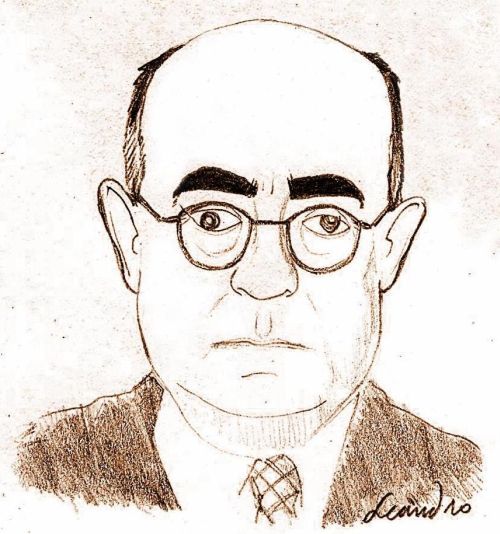
Q: What is antagonistic about the entirety? At that level, aren't all distinctions (and therefore antagonisms) unmade?
A: The entirety (Totality/Brahman) is antagonistic in the sense that it produces change. Sure, in itself the whole is eternal in some sense, but from it has been produced the subject and all the myriad systems and distinctions we see around us. Avoiding the problem of the finite emerging from the infinite (classically, there has been a problem with the self-limiting of the unlimited, or the emergence of evil from within the unchanging fundamental goodness) requires a conception of Brahman/Totality/the Unmanifest that is not really unmanifest. Well, it is, but it is at the same time always manifest, immanent within the manifest. Adi Shankara was on to this insight quite a while ago, and much later Spinoza seems to have figured it out. Substance/Brahman/whatever is not external to the universe, but is that very universe from a different perspective (or the primordial "no perspective", which is, still, a perspective).
The entirety is antagonistic in two senses: first, the phenomenal entierty (which is what I initially had in mind when I borrowed the blog title from Theodor Adorno) is quite antagonistic, as I briefly outlines previously; second, the Absolute in itself is antagonisitc in its real emanations. However, at the same time, the Absolute is also in a different sense changeless.
This contradiction should be analyzed more carefully. At first pass, there is a double meaning to the mantra "sarvam khalvidam brahma"--"all this is Brahman". First, everything's real essence, its unchanging base, is Brahman. Second, everything is Brahman--manifestation is an activity of Brahman, and only therein can Maya be based. Brahman is immanent, not separate from the universe. Brahman would exist without our perception of it, and though names and forms are socially-constructed, the immanent nature of Brahman would remain unchanged. The stuff of which names and forms are fashikoned would exist, and in this sense I remain as materialist as ever.
The universe is always changing, and therefore is always antagonistic. Brahman, which is... I don't want to say coterminous with the universe, but it sort of is, is thus antagonistic. The different levels of in-itself and for-itself and what-have-you are begging to be re-evaluated in light of all this immanentism. So maybe I'll do that.
P.S. I reserve the right to completely disown this entire post as the product of my over-caffeinated and sleep-deprived mind. Have mercy.
Picture: http://commons.wikimedia.org/wiki/File:ADORNO_by_LGdL.JPG
Tuesday, July 30, 2013
Various Undeveloped Thoughts on Various Undeveloped Topics
1. Non-difference, as an ontological category, is based in the idea of difference itself, found between people, discovered through various means such as believing in other minds.
2. Brahman is more "real" than Maya when the former is conceived of as a model. The scale of "reality" of phenomena/experiences only works when the mystical mindset is already in some sense accepted, when one has some portion of "faith", however rational or not.
3. The subject is just an object that disagrees with that designation.
4. Brahman relates to the thing-in-itself in a manner that is precisely analogous to that between Truth and correctness as a formality.
5. Drone music is supremely creative in its very un-creativity. It simply does on the level of the audience what typical music does almost solely on the level of the composer.
6. Conceived of broadly enough, everything is good. Unfortunately, conceived of broadly enough, everything is also bad. Conceived of most broadly, it is neither.
7. The "current of history" or other such formulations are always introduced theoretically after the fact. History is relentlessly objective. This means that the subject ought to become objective to change anything.
8. Objectivity is not just the sum total of subjective conceptions. It is that plus the overcoming of reification/alienation.
9. There can only be an internal world because there is an external one. That both exist is attested to by the ubiquitous conception of duality itself.
10. A little masochism is necessary to prove that one is a living, thinking being.
2. Brahman is more "real" than Maya when the former is conceived of as a model. The scale of "reality" of phenomena/experiences only works when the mystical mindset is already in some sense accepted, when one has some portion of "faith", however rational or not.
3. The subject is just an object that disagrees with that designation.
4. Brahman relates to the thing-in-itself in a manner that is precisely analogous to that between Truth and correctness as a formality.
5. Drone music is supremely creative in its very un-creativity. It simply does on the level of the audience what typical music does almost solely on the level of the composer.
6. Conceived of broadly enough, everything is good. Unfortunately, conceived of broadly enough, everything is also bad. Conceived of most broadly, it is neither.
7. The "current of history" or other such formulations are always introduced theoretically after the fact. History is relentlessly objective. This means that the subject ought to become objective to change anything.
8. Objectivity is not just the sum total of subjective conceptions. It is that plus the overcoming of reification/alienation.
9. There can only be an internal world because there is an external one. That both exist is attested to by the ubiquitous conception of duality itself.
10. A little masochism is necessary to prove that one is a living, thinking being.
Tuesday, July 23, 2013
Non-Dual Non-Experience?
Continuing my previous project of advaitic dialectics, I have several new thoughts which came to me during a discussion with a friend.
The Totality is experienced as a model, and as a model only. When asked the meaning of a poem, one cannot quote the entire poem back to the asker, though this would be the most direct and truthful answer in some sense. Rather, one must provide something which points to the wholeness of the poem without exactly repeating it. One must, in other words, give a model of the poem. Similarly, the Totality cannot be directly experienced or talked about as Totality, because of the previously-mentioned impossibility of squaring the particularity of one's consciousness with the universality of everything. The individuality cannot make the leap to Totality as Totality, but only may commune with it in microcosm, in model.
This brings me to the point that non-dual experience is quite different from non-dual non-experience. A subjectivity experiencing non-duality is going to be quite different from the simple non-duality that lies "outside" subjective/socially-determined forms and names. The singularity/particularity of one's subjective experience is a component of the mystical experience that is quite clearly not present when there is no sufficiently advanced consciousness to have that experience. Owing no small debt to Marx and to Marxian philosophy, I do not believe that the nature of non-duality is in-itself consciousness, but rather that social conditions yada yada yada...
The Totality is experienced as a model, and as a model only. When asked the meaning of a poem, one cannot quote the entire poem back to the asker, though this would be the most direct and truthful answer in some sense. Rather, one must provide something which points to the wholeness of the poem without exactly repeating it. One must, in other words, give a model of the poem. Similarly, the Totality cannot be directly experienced or talked about as Totality, because of the previously-mentioned impossibility of squaring the particularity of one's consciousness with the universality of everything. The individuality cannot make the leap to Totality as Totality, but only may commune with it in microcosm, in model.
This brings me to the point that non-dual experience is quite different from non-dual non-experience. A subjectivity experiencing non-duality is going to be quite different from the simple non-duality that lies "outside" subjective/socially-determined forms and names. The singularity/particularity of one's subjective experience is a component of the mystical experience that is quite clearly not present when there is no sufficiently advanced consciousness to have that experience. Owing no small debt to Marx and to Marxian philosophy, I do not believe that the nature of non-duality is in-itself consciousness, but rather that social conditions yada yada yada...
Thursday, July 18, 2013
Clarification of the Brahman-Totality Relation
Thanks to a good friend and brilliant thinker, I have been pushed to develop a number of concepts or relations that I had previously been pursuing. The first of which, the Totality, I will deal with here.
Objection: Given that Brahman is typically understood as a uniform non-dual experience, how can it be said to be the Totality? The Totality is duality in non-duality or vice versa, so the experience of Totality would need to be experience of distinction in non-distinction, in other words it would need to be experience of the previously-defined Brahman PLUS something extra.
Answer: Non-duality in some sense occurs when one is dead. I believe that state to be different than the awareness of non-duality that is sought in intense meditation. The difference implies that awareness/consciousness, being still subject, is merged with the object, which in this case is thought to be not AN object but THE object, the undifferentiated whole. Experiencing this whole implies a merging of the non-differentiated subject with that object. This is non-differentiated, but it is yet differentiated because the subject and object exist still within the state, though sublated. Therefore, the experience of Brahman is the experience of the Totality (as idea?), even though we typically relate it as being non-differentiated wholeness.
Objection: But what about understanding and knowing everything in the universe? Isn't that the totality?
Answer: That is either impossible (I think it is) or irrelevant. The Totality as perfect merging of subject and object in a single non-dual experience which yet has differentiation is, it is true, not a totality of names and forms. So, it does have all things within it, but in a logical/mystical way, and not as an explicit amalgamation of information. That, too is a Totality, but then again why should there be just one? It is like Hegel's philosophy, in which the idea of difference in non-difference (I can't remember which category, but I think it's the Notion?) is deduced as a separate entity from the really-existing "Totality", as it's called in that context.
Objection: Given that Brahman is typically understood as a uniform non-dual experience, how can it be said to be the Totality? The Totality is duality in non-duality or vice versa, so the experience of Totality would need to be experience of distinction in non-distinction, in other words it would need to be experience of the previously-defined Brahman PLUS something extra.
Answer: Non-duality in some sense occurs when one is dead. I believe that state to be different than the awareness of non-duality that is sought in intense meditation. The difference implies that awareness/consciousness, being still subject, is merged with the object, which in this case is thought to be not AN object but THE object, the undifferentiated whole. Experiencing this whole implies a merging of the non-differentiated subject with that object. This is non-differentiated, but it is yet differentiated because the subject and object exist still within the state, though sublated. Therefore, the experience of Brahman is the experience of the Totality (as idea?), even though we typically relate it as being non-differentiated wholeness.
Objection: But what about understanding and knowing everything in the universe? Isn't that the totality?
Answer: That is either impossible (I think it is) or irrelevant. The Totality as perfect merging of subject and object in a single non-dual experience which yet has differentiation is, it is true, not a totality of names and forms. So, it does have all things within it, but in a logical/mystical way, and not as an explicit amalgamation of information. That, too is a Totality, but then again why should there be just one? It is like Hegel's philosophy, in which the idea of difference in non-difference (I can't remember which category, but I think it's the Notion?) is deduced as a separate entity from the really-existing "Totality", as it's called in that context.
Sunday, June 23, 2013
Advaita Vedanta and Dialectics: Notes Towards a Synthesis
The connection between advaita vedanta
is one that is quite interesting, deserving of far more attention
that it currently receives (as far as I'm aware). Here I will briefly
outline a few points at which advaita vedanta/certain forms of yoga
and dialectics intersect.
- The formless Brahman is nothing but the experience of the Totality.
- This Totality/Brahman is non-dual and contains both everything and nothing (understood of course in different senses).
- Because (in my understanding) Brahman is not a substance and not a primal thing from which all else is produced (as in a traditional theory of God-emanation) there is no logical conflict of cause and effect, of perfect and imperfect, which grips traditional theology.
- Advaita vedanta, if it steers clear of theism, traditional Hindu dharma, organization, &c., is thus not in conflict with dialectics.
Of course, the traditional
understanding of advaita vedanta (even in Gaudapada and Shankara) is
marred by traditionalism, hints of theism, casteism, sexism, and most
of all slavery to scriptural authority and textual exegesis. However,
I hope to develop a combination theory of advaita vedanta and
dialectics, because I see there is no conflict and yet so much to
gain. Too much thought is analytical only, lacking the experiential
component. Hopefully, with this combination an experiential component
can be made explicit within dialectical thought. At the very least,
it will be an interesting curiosity.
Of interest is the book “Advaita
Vedanta: A Philosophical Reconstruction” by Eliot Deutsch. However,
Deutsch is not explicitly a dialectician, and his reconstruction left
me a bit disappointed.
Monday, April 22, 2013
Truth in Marxist Theory
Here is an essay I wrote last semester, which, while I no longer agree with much of it, is still somewhat interesting.
Truth in Marxist Theory: The Problem of the Totality as The Problem of Universals:
A Dialectical Reconsideration
I. Introduction
The concept of truth is a problematic one for modern Marxist philosophers. Throughout the development of Marxian thought, metaphysical concepts have been subjected to intense criticism, and most conceptions of truth are indeed metaphysical. Thus, it has been the task of Marxism to establish a concept of truth that is consistent with materialist dialectics; this is not an easy thing to do. First, the concept must be compatible with the critique of commodity fetishism in particular and reification in general—it cannot simply be a concept denoting what is; it must also take account of the dialectical principle that what is is rather what it becomes, and must further be able to look beyond the surface phenomena to discover the real relations that make up reality and are obscured by hypostasis.
A number of thinkers have attempted to solve the problem of Marxian truth, and thus will be referenced in this connection. A coherent theory of truth within the context of a philosophy of internal relations, such as Marxism, must reference the logical outcome of those relations, namely the totality—the complex of all social relations at all levels of abstraction including emergent properties. The theory of Georg Lukács, espoused in History and Class Consciousness (1923), used the concept of the totality as a major re-appropriation of G. W. F. Hegel for Marxism; hence the prominence of both Hegel and Lukács in our discussion. Lukács posited a totality that was knowable, or at least that the material conditions for that knowledge could be created through practical activity. However, Theodor W. Adorno, a great critic of “identity thinking” (the subsumption of particulars under necessarily ill-suited universals), disputed the concept of the totality on a number of grounds, and thus some of his works and ideas have been included for elucidation of this critique. Adorno's work led to the raising of two main points in this context: (1) all-encompassing concepts (concepts having the quality of totalization) are abstract and meaningless; and (2) descriptions of the totality's specificities are misguided.
In this paper, I will first present the problem of universals for Marxian theory, and then apply this to the specific case of the Marxian totality. Through this exposition, I will mount a defense against the so-called immanent negative theory that would deny the cogency of the totality, while taking into account the valid aspects of its criticism. The defense against the above-mentioned (1) will be based primarily on the manner of conceptual genesis employed—how it differs between totality and Absolute Spirit—and therefore how the type of universals is different. After establishing the need for the totality as a concept and arguing for that concept's coherence, the defense against (2) will take the form of a grounding of the concept in materiality in order to protect it against subjective determinations and idealism. In addition to this, a new conceptual scheme involving multiple totalities—objective, subjective, and conceptual—will be developed and applied for the defense of Lukács.
II. Abstract and Concrete Universals
All thought is abstraction.1 The human subject is bombarded with a mass of sense-data which is “in itself” unstructured. It is the work of the mind to structure this data, putting relevant data together to form discrete objects and present a comprehensible world to one's consciousness. Some data is ignored—for example, at any given moment one does not “see” everything that is in one's field of vision; all data is structured, pressed into categories and objects (Ollman 44-46). The problem is presented by German philosopher Joseph Dietzgen as follows: “Where do we find any indivisible unit outside of our abstract conceptions? Two halves, four fourths, eight eighths, or an infinite number of separate parts form the raw material out of which the mind fashions the mathematical unit. This book, its leaves, its letters, or their parts, are they units? Where do I begin, where do I stop?” (Dietzgen 84).
In other words, particular packets of sense-data are interpreted by the mind, forming a mental representation of the material world.2 There is also another kind of abstraction, however, namely the abstraction of “universals” or “concepts” from these existent objects. It will be helpful to keep in mind that the object is a variable conception, but in general we will assume a given or “fixed” field of objects, and concern ourselves primarily with this second form of abstraction from those objects. Thus the object, as a particular, whatever its boundaries, gives rise to universals. Take the following example: I may abstract the quality of “color” from various colorful objects. “Color” is here our universal, our concept, as opposed to the myriad colorful objects, which are our particulars. Universals, as the direct substance of thought and the locus of discussions of truth, must receive an in-depth analysis.
Following Hegel's lead (and thus that of Lukács), we will here consider two basic types of universals: abstract and concrete. It might help here to review Hegel's philosophical project.3 First and foremost, Hegel was a rationalist and an objective idealist, meaning he attempted to deduce the categories of existence from a “first principle”. However, this first principle couldn't be just any concept; it couldn't be arbitrarily chosen. It had to be the first principle both objectively and necessarily. He reasoned that the pure idea of Being had to be this first principle—whatever we say about anything, we must first say that it in some sense is. But what would it mean to deduce something from something else, namely from Being? One way to think about it is this: The first concept contains what is to be deduced within itself implicitly, and deduction makes the deduced aspect explicit. Hegel's program is to make all that is implicit in Being become explicit. Concepts further on in the system (as he goes on deducing from Being) are more explicit, meaning they show more and more of the truth in themselves. A way to say this is that Being is abstract, whereas, say, Becoming (a subsequent concept) is concrete. Being is abstracted from the differences between everything, leaving only what was the same about all of them, their pure Being. Hegel's process is then to negate Being (supposedly a purely logical operation yielding Not-Being) and subsequently combine the two, yielding Becoming. Becoming contains what is similar and what is different about the earlier concepts—it is thus concrete. It contains the similarity—things that are totally dissimilar obviously cannot be deduced from each other (this amounts to Hegel's belief that ideas contain their opposites within themselves)—and the difference—Being and Not-Being were posited as opposites, and we have subsumed them within Becoming. Although the specifities of Hegel's philosophy were shown to be flawed,4 we might abstract from it and put the distinction the following way:
An abstract universal is a universal that excludes what is different about its species, and includes what is similar. For example, “color” includes what is the same about red and blue, but it does not contain what is different about them. We may abstract (deduce) “color” from the specific colors red and blue, but we cannot deduce the colors red and blue from the idea of color. It is in this sense that we say we “abstract away” this difference. A concrete universal, on the other hand, is a universal that includes what is different between its species and what is the same. In Hegel's philosophy, concrete universals are what allow him to deduce his system of categories—otherwise he couldn't have deduced anything from Being because it was the most abstract concept. Thus, concrete universals were developed so deduction could go both ways, from abstract to concrete and from concrete to abstract:
An abstract universal is a genus which does not contain its species within itself. A wholly new conception of the nature of universals has to be evolved if deduction is to be possible, a conception according to which the universal, the genus, contains its differentiae and its species within itself, so that they can be extricated from it by a logical deduction. Such universals are called by Hegel concrete universals. (Stace 84)
There is, in the above conception, and in the subsequent theorizing of Lukács and Adorno, the assumption that concrete universals are in some sense better than abstract universals5. An abstract universal is empty, whereas a concrete universal is meaningful and useful. Abstract universals exclude the concrete particularities of the historical situation, and thus are not very useful for sociohistorical analysis, which is the self-appointed task of Marxism.
This is particularly important when we add the quality of totalization to our universals. To take an example: Hegel's Absolute Spirit was supposedly the most concrete universal—it lay at the end of his deductive system, it was the most explicitly true category, and as such it contained its entire makeup—all previous concepts in the system—explicitly within itself. To put this idea another way, the Absolute Spirit has no Other, meaning it is total. No categories exist against which it is opposed. This is seen to be necessary because having an Other would permit a further synthesis or inclusion—in other words, the Absolute Spirit would not be so absolute after all; it would be incomplete. Instead of being mediated, this totalized concept is a new immediacy, utterly self-identical. It is here that a problem arises, according to Adorno: “Following Hegel's own argument, such an entity which is not mediated by an other, another concept or real object, is abstract: it is totally indeterminate and empty, something you can arbitrarily attribute properties to—and as such certainly different from the many particular determinations and specific entities it is supposed to contain” (Baumann).
This problem is one with the concept of totalization itself—the absolute inclusion of everything within a supposedly self-identical whole. As Lukács's concept of the totality is a totalized universal, does it then follow that the totality is subject to the same criticism as Adorno mounted against Hegel's totalized universal, namely that it is abstract?
III. Problem (1): The Totality as Universal: Abstract or Concrete?
Lukács was explicit in his belief in the importance of the totality: “Only in this context which sees the isolated facts of social life as aspects of the historical process and integrates them in a totality, can knowledge of the facts hope to become knowledge of reality” (Lukács, History 8)6. Even Adorno admits this, or at least something similar, writing “To comprehend a thing in itself... is nothing but to perceive the individual moment in its immanent connection with others” (Adorno, Negative Dialectics 25). In other words, the totality is the key to understanding the truth of the objects. Without it, epistemic truth is impossible—we would have nothing against which we could in theory measure the truth of a statement. We get, in a rare methodological explanation by Marx himself, a glimpse of this importance: “Even a history of religion that is written in abstraction from this material basis is uncritical” (Marx 494). Critical thought thus lies in the relation of things to materiality—in other words, it lies in their concretion. Note that the following discussion will be limited to the totality's coherence as a concept, due to its importance for truth, and the question of the “filling-in” or description of that totality will be left to the subsequent section.
The totality, as has been said, may be understood as the complex of all social relations, on every level, including emergent properties. Thus, the totality is simply the idea of context (Marx's “material basis”) taken to its logical conclusion—the entirety of something's context. The totality is, much like Hegel's Absolute Spirit, the totalized concrete universal. But what makes the totality properly Marxian as opposed to the idealist Absolute Spirit? Lukács criticized Hegel along the following lines:
Having failed to discover the identical subject-object in history [Hegel's philosophy] was forced to go out beyond history and, there, to establish the empire of reason which has discovered itself... [From that vantage point] History is not able to form the living body of the total system: it becomes a part, an aspect of the totality that culminates in the “absolute spirit”, in art, religion, and philosophy. (Lukács, History 147)
Thus, the totality is not simply context (as things are) but historical context (as things were, are, and will be, “things” being understood as relations or processes). As opposed to this, Hegel's context was an idealist context—not material and social relations but rather conceptual interactions within a closed system of thought; the closed thought was equated with a closed reality, rightly understood as inside that thought.
The question thus presents itself: Is the totality empty and abstract, or is it concrete and meaningful? To answer this, we must analyze the method of conceptual genesis of universals. As Dietzgen pointed out, this method is of the utmost importance. Universals are not simply givens, but are mediated by complex mental processes both conscious and unconscious. In what manner do we form our conception of the totality, and is that manner different than the way Hegel formed his Absolute Spirit? If it is different, can the manner of conceptual genesis we employ save the totality from the allegations of emptiness and pure abstraction that have plagued Hegel's philosophy?
First, Hegel's deductions were of a purely formal, conceptual character. Abstracting from differences, he began with a purely abstract conception of Being. Deduced from this starting point, his further concepts could only ever remain abstract. In contrast, the totality begins with the objects in their multiplicity, and does not deduce things purely logically, subsuming them within further concepts that do violence to the multifarious differences within them. The totality is formed by a conglomeration of processes, a successive concretization not based on subsumption but on an interaction of “contradictory” tendencies, or tensions. For example, Marx's economic analysis progresses from simple reproduction to expanded reproduction, drawing on the mathematical relations of the former to better understand relations in the latter, though the former is not an existent condition (Marx 711-32). In other words, Marx's further concepts are not synthetic unities; rather, they retain the tension of the previous concepts, as the social and material tensions of commodity exchange are not resolvable by thought alone, but only in practice. Lukács saw this and laid the basis for a “scientific” view of the totality, which will be looked at in more detail in the next section. Remember that we do not need to be able to delineate how we are actually capable of discovering the truth of the totality for the concept to be useful, in the sense of providing for a concept of truth, at least hypothetically.
As further concepts are added, as the analysis becomes more and more concrete, the approximation of reality becomes more and more sophisticated. However, as we continue this task of expanding our theory to include more and more relations, a paradox makes itself clear to us: once we contain all relations in our explanation, once we have totalized our social concept, we lose all meaning according to the criticisms, and have gone from concreteness over into abstraction. It is apparent here that something has gone wrong. What in the quality of totalization makes a concept lose its meaning? In light of this, we must look more closely at the term “totalization”.
The quality of totalization, of a concept or thing being total, implies that there is nothing existing outside of it. For Hegel's system, this was manifest in the total self-identity of the Absolute Spirit—it had no Other because it contained its Other within itself. It was the final link in the long chain of Hegel's deductive system, and nothing could be outside it as it was defined. For the totality, this is also the case. The reason why totalization might cause abstractness is that it yields a concept that is non-contextualized—it has no context but is existent purely in itself. However, the totality can be understood as the idea of context itself. Pure context is necessarily decontextualized in the sense of being mediated by a further idea of context; it is already and always immediate in that sense. And indeed this is the problem to which Adorno draws attention: the totality is unmediated mediation. For other concepts, for non-totalized universals, this implies that they are ideological or reified, being torn from their specific, concrete context and hypostatized by the subject.
Whether this also holds for the totality is a different question, however, and is best answered by recourse to the previous argument: the totality is mediated not explicitly by conceptual opposition from outside it or by further abstractions, but by material existence, understood in two ways: first, as the particulars contained inside it conceptually; and second, as the particulars of “reality”, of subjective experience. This first way simply means what has been said before about the method of conceptual genesis leaving the particular tensions intact. The second way implies something “outside” the realm of theory, of the qualia of subjective experience. This has the important implication that something may be outside the totality as concept, against which the concept is tested. This is the concept-object relation it undergoes during critical thinking and experience—the totality must not be hypostatized. But how does the totality as a concept relate differently to its object than the particulars of experience relate to their own partitioning? I argue that this is due to the quality of totalization. However, to make sense of this claim, we will need to develop a new way of looking at the problem.
IV. A New Conceptual Scheme
Here I propose to make a further distinction between the objective totality, subjective totalities, and totality-concepts; until now we have been speaking only of the objective variety and the concept of that objective variety, and thereby running the risk of hypostasis, of the idealism that is equating subjective experience and objective reality. The subjective totalities are the various thought-concretes that arise from mental representation, the operation of which constitute particulars in a conceptual scheme and present those particulars to the subject of consciousness. In this way, subjective totalities are the total horizons of subjectivity, and hence total in a different sense than is the objective totality. The subjective totalities are altered by the action of the forces and tensions of the objective totality. It is apparent that the subjective totalities are contained within the objective totality, as is the third type of totality, the totality-concept. The totality-concept may be that of the objective or subjective totalities, and is simply the conscious mental representation of them.
These sundered totalities are of a different type than the Absolute Spirit, which was in some sense all three types of totality in one. This lack of differentiation—caused by Hegel's equating of thought and existence, and of consciousness and unconsciousness—led him to difficulties. As against his idealism, the opposition of the three must be held, with each subsumed in the more comprehensive and less-comprehensible level. The concept of truth thus becomes a kind of isomorphism between these three levels. Whether this is possible to achieve is a different issue, dealt with in the next section. For now, we will analyze how this scheme relates to the formerly-defined categories of abstract and concrete.
Prior to our three-level scheme of totality, we had a simpler two-level scheme, which denied the antagonism of conscious and unconscious mental operation, and was hence a kind of hidden idealism, a positing of the equality of thought-concrete and real-concrete. The abstractness or concreteness of our analysis was restricted to this bare equality, which impressed upon it the inability to avoid hypostasis. Our method of conceptual genesis was in that case stunted, and concretion threatened to be limited by the unaccounted-for horizons of the individual subjectivity as opposed to that of our concepts.
V. Problem (2): The Description of the Totality
Having established the coherence of the totality and presented a new conceptual scheme for dealing with the concept, we turn now to the problem of description, the material grounding of the totality in reality. A first step was made in the above description, by the very nature of the scheme as one containing multiple levels of interaction. We must, however, consider the usefulness of this description of the totality. Lukács clearly did not view the totality as a simple theoretical object, but rather something that could be studied, yielding economic and political insights.7
The problem for both Lukács and Hegel was the finding of the “subject-object” of history, the combined knower-and-known whole, the totality. For the latter, this was the Absolute Spirit; for the former, it was the proletariat. As both the subject of history (the active doer, the would-be totality of society after the communist revolution) and the object of history (the passive “done-to”, the would-be all of society, also the totality), the proletariat was thought to have the ability to overcome the problem of truth by creating its own social conditions, since the problem of truth was essentially the problem of the given, reified particular. Thus, the totality could only be fully known when the proletarian revolution had been successful—this is one version of the famous unity of theory and practice. It is stated by Rockmore as follows: “Lukács maintains that the proletariat makes history and therefore can know it. In this way Lukács supports his claim that Marxism surpasses the supposedly fictitious Hegelian idea of the absolute to grasp the real historical subject” (Rockmore).
This is Adorno's criticism: Lukács supposes that the totality can only be known after the proletarian revolution, which is supposing some description of the totality, something that it is not legitimate to suppose. This is because he assumes that the proletariat is the aforementioned subject-object of history, which is dependent on the character of the unknowable totality. In the words of Nicholas Joll: “Adorno believes that one cannot specify the correct epistemic relation between subjects (knowers) and objects. The reconciled condition will be so novel that any anticipation of it will be marked 'by the same distortion and indigence which it seeks to escape'. Adorno infers that 'the full object' is not to be 'positively pictured'” (Joll).
We shall see that this argument is very different from the one advanced as (1) in the previous sections. There, Adorno denied the totality due to its abstractness, where here it is denied due to the epistemic environment of current existence.8 Let us now examine this new criticism in more detail.
The idea that “Practice itself was an eminently theoretical concept” is one that sheds some light on the problem (Adorno, Negative Dialectics 144). Lukács could not seek recourse to practice because his concept of “practice” was just that—a concept. He could not say that the truth would be reached through a certain course of action because that course of action was itself articulated theoretically. The correct epistemic relation to the objects was not as easily knowable as that. But, we must ask, what is barring the understanding completely and totally from truth? Is it impossible, as Adorno alleged, to articulate a course of action that could lead to the resolution of the problem of knowledge?
VI. The New Scheme Applied: A Critical Re-interpretation of Lukács
The tripartite framework of interwoven totalities points the way to the resolution of the problem of truth. Having articulated a coherent theory of truth—the isomorphism or symbolic equation of the three totalities—we must ask how truth may be reached, and if we cannot come up with an answer, our theory will be quite useless, although still interesting. It is here that the method of conceptual genesis resurfaces; the formation of the totality-concept is related to the formation of the subjective totality, which is related to the objective totality. The formation of the concept is inseparable from both of our two previously-posed problems—form is inseparable, though distinct, from content.
The relation of the totalities is of the utmost importance. The totality-concept has epistemological access to the subjective totality, which then has access to the objective totality. This means that there are two interactions we can consider, without jumping the gap. In other words, previous attempts at truth were restricted by the fact that the totality-concept was related directly to the objective totality, when in reality it can only be legitimately related to the subjective totality. Thus, the task of discovering truth lies not in “directly perceiving” the objective totality, which is impossible, but in alteration of the nature of the subjective totality as the mediating concept between the two others. This takes us back to Lukács, except in a more sophisticated scheme—to find truth, we must establish a social order, a complex of social relations that relates the subjective and objective totalities more fully, which would then allow for the formation of a totality-concept that coincides with the objective totality isomorphically. There are thus two considerations we must make here: (a) the possibility of articulating the material and epistemic conditions for the double-isomorphism of subjective and objective totality, and (b) the conditions for the method of genesis of the totality-concept from those relations.
Lukács really sought for the triple-isomorphism without explicitly considering that there were indeed three parts. The subjective totality can be directly formulated as a concept through the theory and techniques of psychoanalysis and phenomenology. We can directly know the variations and qualities of subjectivity, simply by experience and by analysis. But how can we create the conditions of subjective socialization that correspond to reality, to the objective totality which we cannot experience? The answer lies in the deconstruction of ideology, of false concepts and of the tendency to hypostatize, the alteration of those subjective horizons. This is where Adorno once again re-enters the picture. The conditions of ideological deconstruction are those that relate the subject critically and negatively to the falsely-presented world in which she is situated. Through Adorno's negative theory, we come to understand that the world is not as our concepts would have it, and further that these concepts are mediated by our subjective totalities. His work implied that we cannot relate the objective totality to its concept, and this is true. However, a relation of our subjective totalities to our concept of the subjective totality is permissible, because we can know our subjective totalities. Knowing the relation of concept to subjective totality, we know several links of our tripartite chain. The material and epistemic conditions which yield a collective consciousness in what was previously restricted to the unconscious—in other words, what yields Lukács's subject-object—is what is to be striven for, because that is a direct creation of the conditions of existence and of subjectivity as opposed to the passive acceptance of the reified given.
Why does the conscious creation of subjectivity bridge the gap and penetrate the truth of the objective totality? The creation of subjectivity lies in the sphere of objectivity, or else all is solipsism. Thus, we come to know the objective totality through manipulation of the subjective. We cannot, in the last analysis, know the objective totality directly in the sense of conceptualizing it as it exists, but rather we act in and through it. The theory of acting in this manner is thus the theory of the objective totality. Hence we have a defense of Lukács's conception of praxis.
Something must here be clarified: how does our new understanding withstand the criticisms of the type espoused by Adorno? It withstands (1) because it's method of genesis is not one of synthesis; it withstands (2) because it works outside the realm of subjectivity, though it works on that very subjectivity. Our theory denies that we cannot know, because we can know through knowledge of and action upon our subjective totalities. The concept of practice is no longer simply theoretical or conceptual—it works not on concepts but on the psyche, and in terms dictated by that psyche; those terms may be concepts, but they are able to be directly related to their object, the subjective totality . Thus, it escapes the criticism by relating concretely to a directly knowable subjective reality.
VII. Conclusion
Without being allowed any access to the objective totality, analysis becomes an analysis of the given. An organic evolution of social relations cannot be adequately pictured, much less a truly revolutionary situation. Adorno's dialectics are, curiously, to borrow Walter Benjamin's phrase, “Dialectics at a standstill” (Benjamin, qtd. In Buck-Morss 127). The concept of the subjective totality re-introduces practice, and hence true temporality, into Marxian theories of truth. The epistemological conditions that allow us access to truth must be put forth as a kind of psychoanalytic Marxism.9 An area for further theorizing would be the way the relations of society socialize its members and constitute them as subjects.10 While these theories must continually be put to trial by the critical intellect, theoretically the concepts are coherent. The totality (now conceptualized as multiple totalities) is seen to be essential for the prescriptions of revolutionary Marxism. The specifities of the conjuncture in which conscious creation of subjectivity is possible must unfortunately be left to subsequent analysis. Perhaps Adorno's saying, “Wrong life cannot be lived rightly”, is true in some sense, but we must take care not to hypostatize this “wrong life” (Adorno, Minima Moralia 39). Wrong life can be made right, and not in the way Adorno refuted with the concept of theoretical practice.
Bibliography
Adorno, Theodor W. Minima Moralia : Reflections From Damaged Life. Trans. E. F. N. Jephcott. London: Verso, 2005. Print.
Adorno, Theodor W. Negative Dialectics. Trans. E. B. Ashton. London: Continuum Press, 1973. Print.
Adorno, Theodor W. “Sociology and Empirical Research.” The Positivist Dispute in German Sociology. Trans. Glyn Adey and David Frisby. Farnham, Surrey, UK: Ashgate Publishing, 1981. Print.
Baumann, Charlotte. "Adorno, Hegel and the Concrete Universal." Philosophy & Social Criticism 37.1 (2011): 73-94. Print.
Buck-Morss, Susan. The Origin of Negative Dialectics : Theodor W. Adorno, Walter Benjamin and the Frankfurt Institute. New York: Free Press, 1977. Print.
Dietzgen, Joseph. The Positive Outcome of Philosophy. Trans. Ernest Untermann. Chicago: Charles H. Kerr & Co., 1906.
Finlayson, Gordon. "Adorno: Modern Art, Metaphysics and Radical Evil." Modernism/modernity 10.1 (2003): 71-95. Print.
Joll, Nicholas. "Adorno's Negative Dialectic: Theme, Point, and Methodological Status." International Journal of Philosophical Studies 17.2 (2009): 233-53. Print.
Lukács, György. History and Class Consciousness: Studies in Marxist Dialectics. Trans. Rodney Livingstone. Cambridge, Mass.: MIT Press, 1971. Print.
Lukács, György. Lenin: A Study on the Unity of His Thought. Trans. Nicholas Jacobs. London: Verso, 2009. Print.
Marx, Karl. Capital : a Critique of Political Economy. Trans. Ben Fowkes. New York: Penguin Classics, 1990. Print.
Ollman, Bertell. Dance of the Dialectic : Steps in Marx’s Method. Urbana: University of Illinois Press, 2003. Print.
Rockmore, T. "Fichte, Lask, and Lukacs's Hegelian Marxism" Journal of the History of Philosophy 30.4 (1992): 557-77. Print.
Stace, W. T. The Philosophy of Hegel: a Systematic Exposition. New York: Dover Publications, 1955. Print.
Footnotes
2 Bertell Ollman has dealt extensively with this aspect of the problem in his many works.
3 The explanation given in this paragraph is in some sense a summary of W. T. Stace's The Philosophy of Hegel.
4 See, for example, Stace.
5 Take, for example, the following statement by Lukács: “By contrast [to bourgeois abstractness], in the teeth of all these isolated and isolating facts and partial systems, dialectics insists on the concrete unity of the whole” (Lukács, History 6).
6 And again, on the totality's importance for Marxism: “It is not the primacy of economic motives in historical explanation that constitutes the decisive difference between Marxism and bourgeois thought, but the point of view of totality” (Lukács, History 27).
7 For example, Lukács writes that “Nor can a single isolated event, regardless of whether it is a victory or a defeat, possibly decide [the eventual outcome of proletarian revolutionary activity]” (Lukács, Lenin 38), with the implication that the totality is decisive as against the particulars.
8 It is characteristic of Adorno that even the “good” is not posited concretely, but rather we are left with the idea that current existence is undeniably bad, “radically evil” (Finlayson). Adorno confines his critique to how bad things are now.
9 See, perhaps, Slavoj Žižek and Alain Badiou.
10 For example in the work of Louis Althusser.
Thursday, November 8, 2012
Abstract, Concrete, and the Totality
It is useful to consider two kinds of
universals: abstract and concrete. First we will take a quick look at
the former, then a quick look at the latter, then a longer look at
various problems that arise therefrom.
An abstract universal is a universal
that excludes what is different about its species, and includes what
is similar. For example, “color” includes what is the same about
red and blue, but it does not contain
what is different about them. It is in this sense that we say we
“abstract away” this difference.
A
concrete universal is a universal that includes what is different
between its species rather than what is the same. The classic example
of a concrete universal is Hegel's Becoming, which contains both
Being and Not-Being within itself. In Hegel's philosophy, concrete
universals are what allow him to deduce his system of categories—you
can't deduce the color blue from the idea of color because what makes
blue itself and not red is explicitly excluded
from the idea of color because it is abstract.
Where
it gets more interesting (and relevant) is that Lukács
argued for a conception of the totality that was a concrete universal
in the manner of Hegel. The totality, as the complex of all social
relations (as they are becoming), is clearly a concept that does not
expressly exclude the individual moments in their particularity but
attempts to include them within itself. Further, as a totality,
the totality is a whole, meaning it has no other outside of itself.
This is where the problems come in.
Adorno
argued that the totality was not actually a concrete universal but
rather was abstract. (Actually, as far as I know he expressly argued
that Hegel's version was abstract, but the same applies to Lukács
as well.) The point for Adorno was that the totality had no other,
and hence was simple self-identity, empty and undefined because of
it's lack of oppostion.
Is
Adorno correct? Does the concept of the totality have meaning or is
it simply a vacuous mystification? This is obviously a very important
question for theoretical Marxism. While I'm not entirely up-to-date
on the literature, I can attempt to venture an answer.
The
totality is not a mental construction in the same way that Hegel's
Absolute Spirit was. The totality, properly conceived, is simply the
largest complex of processes thinkable. Tension and opposition
continue to exist inside the concept, unlike in the reconciliation of
Hegel. The antagonisms of constituent parts or processes are not done
away with at higher levels. Note that the same might be attributed to
Hegel, although in that case I would say that it is not true; the
Marxist totality is a concept (hopefully) functioning as a model of
all the myriad tensions of society. It is not just a philosophical
model, but also a sociological and economic one. In other words, the
meaning of the totality is not lost as tensions are subsumed within
it.
It
might be objected here that I am hypostatizing the totality. However,
a dogmatically-posited totality is different from a totality that is
constantly checked against material conditions, against reality, and
constantly re-abstracted and adjusted based on changing conditions.
Not for nothing have Marxists historically insisted on “science”,
in the sense of being interested in reality. The findings of
psychology, sociology, economics, etc. must be scrutinized and
analyzed, pieced together into a totality which can then be utilized
as a category of mediation for the further analysis of social
phenomena.
The
totality is real. The fact that we cannot positively picture it is
problematic, to be sure, but guesswork and approximations don't
magically lose their relevance. Something really existing must be
checked, concept against object, to get a legitimate understanding of
it. That attempt is an optimism Adorno did not have, and possibly for
historical reasons (Auschwitz, WWII, etc.).
Subscribe to:
Posts (Atom)