Pages

Showing posts with label maya. Show all posts

Tuesday, August 6, 2013

A Brief Thought on Antagonism

Homogeneous oneness is outside; differentiae are inside--in the mind. So the idea of the many is the creation of the mind.
So sayeth Swami Vivekananda (from Inspired Talks in The Yogas and Other Works p.543).

In light of this idea, there is a lot of work to be done on a concept of antagonism that does not rely on the typical idea of difference as combated so eloquently by the Swami. Homogeneity has to rub up on itself in a non-different way, producing myriad differences and even subjectivity. Sounds tough, but I'll get to work on it.

Saturday, August 3, 2013

What Is Antagonistic About the Entirety?


Q: What is antagonistic about the entirety? At that level, aren't all distinctions (and therefore antagonisms) unmade?

A: The entirety (Totality/Brahman) is antagonistic in the sense that it produces change. Sure, in itself the whole is eternal in some sense, but from it has been produced the subject and all the myriad systems and distinctions we see around us. Avoiding the problem of the finite emerging from the infinite (classically, there has been a problem with the self-limiting of the unlimited, or the emergence of evil from within the unchanging fundamental goodness) requires a conception of Brahman/Totality/the Unmanifest that is not really unmanifest. Well, it is, but it is at the same time always manifest, immanent within the manifest. Adi Shankara was on to this insight quite a while ago, and much later Spinoza seems to have figured it out. Substance/Brahman/whatever is not external to the universe, but is that very universe from a different perspective (or the primordial "no perspective", which is, still, a perspective).

The entirety is antagonistic in two senses: first, the phenomenal entierty (which is what I initially had in mind when I borrowed the blog title from Theodor Adorno) is quite antagonistic, as I briefly outlines previously; second, the Absolute in itself is antagonisitc in its real emanations. However, at the same time, the Absolute is also in a different sense changeless.

This contradiction should be analyzed more carefully. At first pass, there is a double meaning to the mantra "sarvam khalvidam brahma"--"all this is Brahman". First, everything's real essence, its unchanging base, is Brahman. Second, everything is Brahman--manifestation is an activity of Brahman, and only therein can Maya be based. Brahman is immanent, not separate from the universe. Brahman would exist without our perception of it, and though names and forms are socially-constructed, the immanent nature of Brahman would remain unchanged. The stuff of which names and forms are fashikoned would exist, and in this sense I remain as materialist as ever.

The universe is always changing, and therefore is always antagonistic. Brahman, which is... I don't want to say coterminous with the universe, but it sort of is, is thus antagonistic. The different levels of in-itself and for-itself and what-have-you are begging to be re-evaluated in light of all this immanentism. So maybe I'll do that.

P.S. I reserve the right to completely disown this entire post as the product of my over-caffeinated and sleep-deprived mind. Have mercy.


Picture: http://commons.wikimedia.org/wiki/File:ADORNO_by_LGdL.JPG

Friday, August 2, 2013

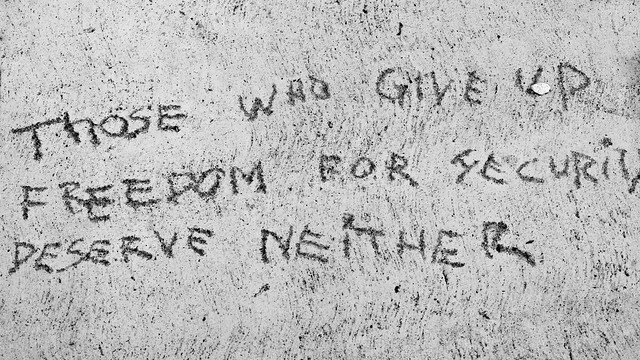
Freedom and Security: Society as Phenomenality


So this horrendous Ariel Castro deal led me to some thoughts...

The specific cultural logic in which we live (capitalism, patriarchy, the racial order, etc.) presents itself to us as Reality. This Reality is one of dualism, in other words Maya. The capitalist structure of government and social interaction creates not only opposing (as in logically negated) concepts, but forces concepts into opposition in novel and shitty ways. For example, the opposition between security and freedom that is so often discussed. This rests on a specific and unnecessary opposition between the two concepts, resting on (of course) private property relations. People believe they have the right to do whatever they want with/on their property. Privacy conceptions (as opposed to private property ownership) interact dialectically with the technical level of society, often reacting against the technological development which has engendered a state or conception of non-privacy. Next (or before, as the case may be) the ideology of property comes in, strengthened.

These considerations lead me to believe that opposition occurs due to social context (the old Marxist axiom). Thus they are highly variable. Formal logic's insistence on "logical negation" is contrived on two levels: the way people interact with the world, and cultural logic on a social level, do not conceive of binary negation, meaning there is always a "taintedness" to concepts; second, the individual concept of binary negation is doubly contrived because it is based on social context as well as on a process of dry abstraction which cuts horizontal relations completely out of the picture, thus bastardizing even the social context. There is no such thing as negation on the level of Brahman, of course. Maya functions on the level of phenomenality--in other words, on the level of the social.

So going back to Castro, ideally there would be no ability to do what he did, or to do a lot of related-but-not-as-extremely-shocking things that happen much more commonly and on a much wider scale, because there would be no debate on security and freedom, no conception of private property on which that could base itself, and no socially-defined opposition between the two things that I'm sure everyone wants: freedom and security.

Picture: http://www.flickr.com/photos/thomashawk/8026418953/ 

Tuesday, July 30, 2013

Various Undeveloped Thoughts on Various Undeveloped Topics

1. Non-difference, as an ontological category, is based in the idea of difference itself, found between people, discovered through various means such as believing in other minds.

2. Brahman is more "real" than Maya when the former is conceived of as a model. The scale of "reality" of phenomena/experiences only works when the mystical mindset is already in some sense accepted, when one has some portion of "faith", however rational or not.

3. The subject is just an object that disagrees with that designation.

4. Brahman relates to the thing-in-itself in a manner that is precisely analogous to that between Truth and correctness as a formality.

5. Drone music is supremely creative in its very un-creativity. It simply does on the level of the audience what typical music does almost solely on the level of the composer.

6. Conceived of broadly enough, everything is good. Unfortunately, conceived of broadly enough, everything is also bad. Conceived of most broadly, it is neither.

7. The "current of history" or other such formulations are always introduced theoretically after the fact. History is relentlessly objective. This means that the subject ought to become objective to change anything.

8. Objectivity is not just the sum total of subjective conceptions. It is that plus the overcoming of reification/alienation.

9. There can only be an internal world because there is an external one. That both exist is attested to by the ubiquitous conception of duality itself.

10. A little masochism is necessary to prove that one is a living, thinking being.

Saturday, July 27, 2013

Thoughts into Words

It's very hard to put thoughts satisfactorily into words unless there is an external force to push up against. This is why it is so important to have good intellectual friends. Typically, one has very little ability to self-judge one's ideas. Not to say that the experience of that idea beyond the veil of language (a very real veil to be sure) is unable to to assessed, but it is true that those subjective experiences typically are quite formless, and must go through a miniaturized process of pseudo-manifestation (not to be confused with the manifestation or formlessness of the absolute).

So, one must have an opposition of some sort or another, against which one's thoughts and modes of subjectivity may take form. The form taken depends on a wide variety of objective factors (and even, indeed, one's subjective semi-formless experience is, as a piece of the whole, determined by these as well). And then again the particular form taken reacts back upon the subjective inner sanctum, in good dialectical fashion, and so on goes the evolution of thought. In fact, the places to which we are led by phenomenal thought are often of quite a different nature than was our initial intuitive understanding. One thing that is often forgotten, especially in spiritual circles, is that the intuition itself develops in dialectical interaction with other, non-intuitive forms of knowledge. The influences of society, of the phenomenal universe, are paramount in shaping how we view both the phenomenal and the non-phenomenal.

The question arises: What is the relation between the socially-determined world of phenomenality/society and the so-called eternal Absolute, non-phenomenality, the Unmanifest? The complete indeterminate quality (or better yet, non-quality), the non-duality of Brahman, leads one to conclude (although prematurely) that Brahman is un-social, eternal in the old-timey metaphysical sense of the word. This, however, is not the case, because of the social construction of the phenomenal reality against which that non-duality is opposed. Of course, this is only part of the solution, namely that from the point of view of Maya, phenomenality. What about from the viewpoint of the Absolute? Is that, then, social or unsocial in its self-understanding? The answer, of course, is that it is neither, because it is beyond distinctions like this, from its own perspective only, however. One would do well to keep in mind that to progress to the non-dual in any sense of the term, and to speak of it of course, we must bow to the inescapable logic of the plane in which we live and work and philosophize.